

Overview |
This issue features iconic 20th-century works by three celebrated Australian photographers.
Issue date | 24 March 2026 |
Issue withdrawal date | 1 October 2026 |
Denomination | 3 x $1.70 |
Stamp Design | Simone Sakinofsky, Australia Post Design Studio |
Product Design | Jason Watts, Australia Post Design Studio |
Paper: gummed | Tullis Russell 104gsm Red Phosphor/Blue PVA Stamp Paper |
Printer: gummed | RA Printing |
Printing process | Offset Lithography |
Stamp size (mm) | 2 x $1.70: 35 x 35 1 x $1.70: 37.5 x 26 |
Minisheet size (mm) | 135 x 80 |
Perforations (mm) | 2 x $1.70: 14.28 x 14.28 1 x $1.70: 13.86 x 14.6 |
Sheet layout | Module of 50 |
FDI Postmark | Sydney, NSW 2000 |
FDI Withdrawal date | 22 September 2026 |
Stamps in this issue
David Moore, Migrants arriving in Sydney 1966
David Moore (1927–2003) trained in Sydney and worked with renowned photographer Max Dupain before traveling to London in 1951. The first Australian photojournalist to work for international picture magazines such as Time-Life, Moore’s photographs were included in the famous 1955 Family of Man exhibition in New York. From the 1960s Moore was based in Australia.
Perhaps Moore’s best-known photograph, Migrants arriving in Sydney 1966, shows European post-war immigrants surveying their new country with both anticipation and trepidation.
The photograph is reproduced with the permission of the Estate of David Moore, © Lisa, Michael, Matthew and Joshua Moore.
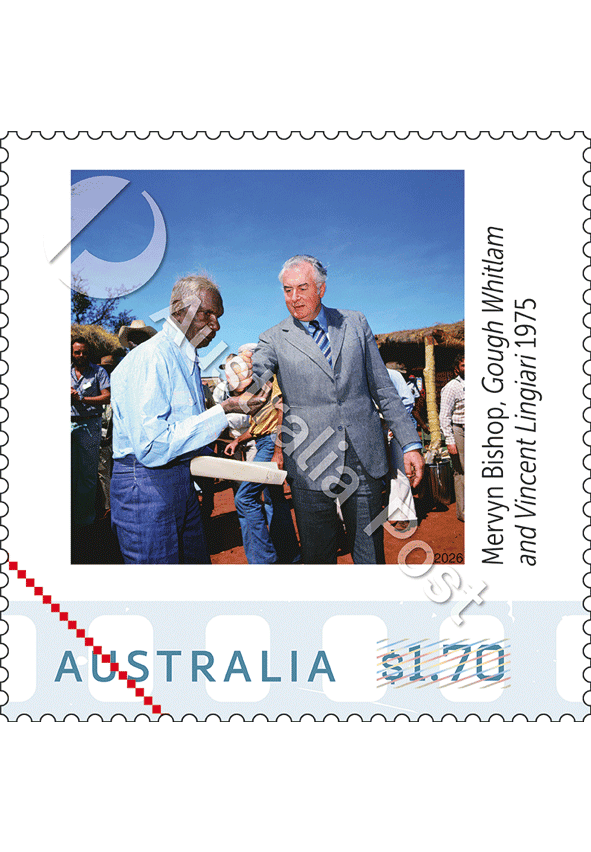
Mervyn Bishop, Gough Whitlam and Vincent Lingiari 1975
Australia’s first Indigenous professional photographer, Mervyn Bishop (1945– ) was born and raised in Brewarrina, New South Wales. At the age of 17 he was awarded a cadetship at the Sydney Morning Herald and in 1971 won the News Photographer of the Year Award. In 1974 Bishop began work at the Department of Aboriginal Affairs in Canberra.
It was an important era in Indigenous self-determination. Prime Minister Gough Whitlam pours soil into the hands of traditional landowner Vincent Lingiari, Northern Territory 1975 shows the symbolic handing over of the title deeds to 3,250 square kilometres of Gurindji country at Daguragu (Wattie Creek) on 16 August 1975, the first time the Commonwealth government had returned land to its original custodians.
This event was the culmination of a nine-year struggle by the Gurindji people for land rights, beginning with the Wave Hill Walk-off in 1966, a strike by Aboriginal stockmen and their families, led by Vincent Lingiari, at Wave Hill station in the Northern Territory. It began as a protest over poor wages and working conditions, but it grew into a demand for land rights, becoming a landmark moment for the Aboriginal land rights movement. The nine-year protest ultimately led to the Aboriginal Land Rights Act (Northern Territory) 1976.
The photograph is reproduced courtesy of the photographer Mervyn Bishop & agent Josef Lebovic Gallery, Sydney, and Family Group of Vincent Lingiari belonging to the Gurindji people of the Northern Territory.

Anne Zahalka, The Bathers 1989
Sydney-based Anne Zahalka (1957– ) is a photo-media artist with a career spanning 40 years. Her practice deconstructs familiar scenes, re-presenting them to allow for alternative narratives that reflect on cultural diversity within Australian society and, in recent years, the ecological impact of the global climate crisis.
Her well-known work, The Bathers 1989, is from the series “Bondi – Playground of the Pacific”. The composition and theme of the carefully staged photograph directly references artist Charles Meere’s popular 1940 painting Australian Beach Pattern in the collection of the Art Gallery of New South Wales. Zahalka, however, has reenvisaged Meere’s Anglo-centric, idealised masculinist interpretation to draw attention to the cultural realities of post-World War II Australia.
The photograph is reproduced with the permission of Anne Zahalka © Anne Zahalka/Copyright Agency, 2025
This content was produced at the time of the stamp issue release date and will not be updated.
Shop our Stamp Collectables
-
-

First Day Cover (Gummed)
-

Stamp Pack
-

Maxicards