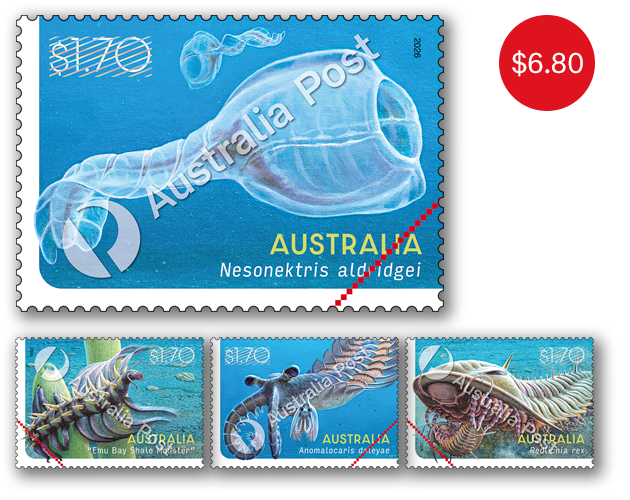
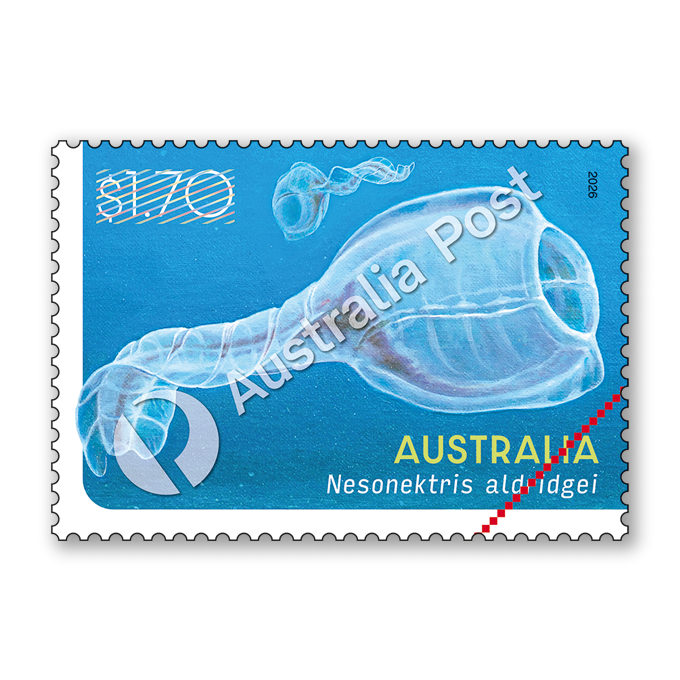
OverviewThis issue features prehistoric creatures that lived on our continent around 500 million years ago, in the early Cambrian Period of the Palaeozoic Era. At this time, organisms had not yet emerged from the water to live on land. They had, however, developed skeletons, shells and other external and internal hard structures through the process of biomineralization. This evolution started an “arms race”, where some animals developed hard body parts to prey on other organisms. These prey animals in turn evolved features such as spines, hard coverings, digging and fast-swimming mechanisms to avoid being eaten. The fossils of the extraordinary early Cambrian creatures on the stamps were found in Emu Bay Shale deposits on Kangaroo Island, South Australia. This stamp issue represents the latest in palaeontological research. The artist, Peter Trusler, has collaborated with palaeontologist Associate Professor Diego Garcia-Bellido of the University of Adelaide in the illustration of this issue. IllustratorIllustrations are by award-winning artist and scientist Peter Trusler. Trusler has contributed to much original research within the field of palaeontology through his work in illustrating fossil specimens and reconstructions of extinct organisms. He is the namesake for the extinct monotreme Teinolophos trusleri, discovered on the Victorian coast in December 2000, a significant find for which he illustrated the holotype specimen. Trusler has previously illustrated several other stamp issues for Australia Post featuring prehistoric animals: Australia’s Dinosaur Era (1993), Creatures of the Slime (2005), Megafauna (2008) and Australian Dinosaurs (2022). All represented cutting-edge research in consultation with palaeontologists. |
Issue date | 10 February 2026 |
Issue withdrawal date | 1 September 2026 |
Denomination | 4 x $1.70 |
Stamp typography & product design | Jason Watts, Australia Post Design Studio |
Medallion cover & collection design | Keith Downes, Pixelad |
Illustration | Peter Trusler |
Paper | Tullis Russell 104gsm Red Phosphor/Blue PVA Stamp Paper |
Printer: gummed | Southern Impact |
Printing process | Offset Lithography |
Stamp size (mm) | 37.5 x 26 |
Minisheet size (mm) | 170 x 80 |
Perforations (mm) | 13.86 x 14.6 |
Sheet layout | Module of 50 (2 x 25) |
FDI Postmark | Adelaide, SA 5000 |
FDI Withdrawal date | 11 August 2026 |
Stamps in this issue
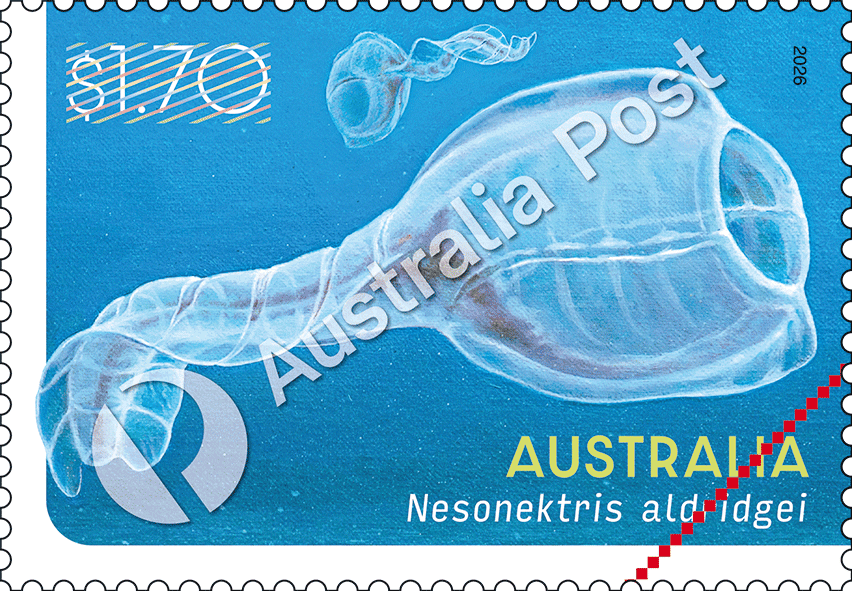
Nesonektris aldridgei
Nesonektris aldridgei was a large vetulicolian (swimming chordate) that grew to around 18 centimetres in length. It had a streamlined body, a mouth opening at the front and a flexible tail probably used to propel it away from predators.
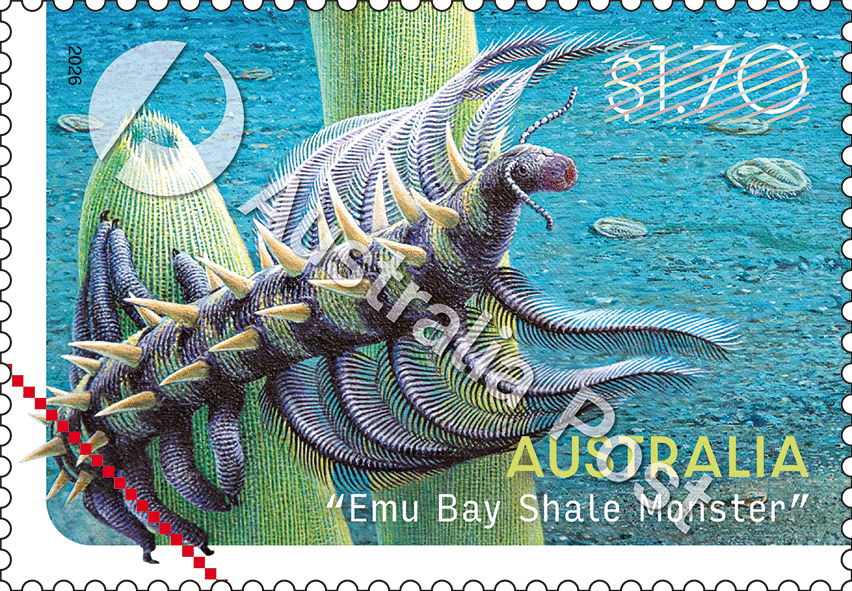
“Emu Bay Shale Monster”
The four-centimetre-long lobopodian, informally known as the Emu Bay Shale Monster was a soft-bodied, velvet worm-like creature with protective spines on its back and body segments bearing pairs of spiny filter-feeding legs in the anterior body and short anchoring lobopods (stubby legs) in the posterior part.
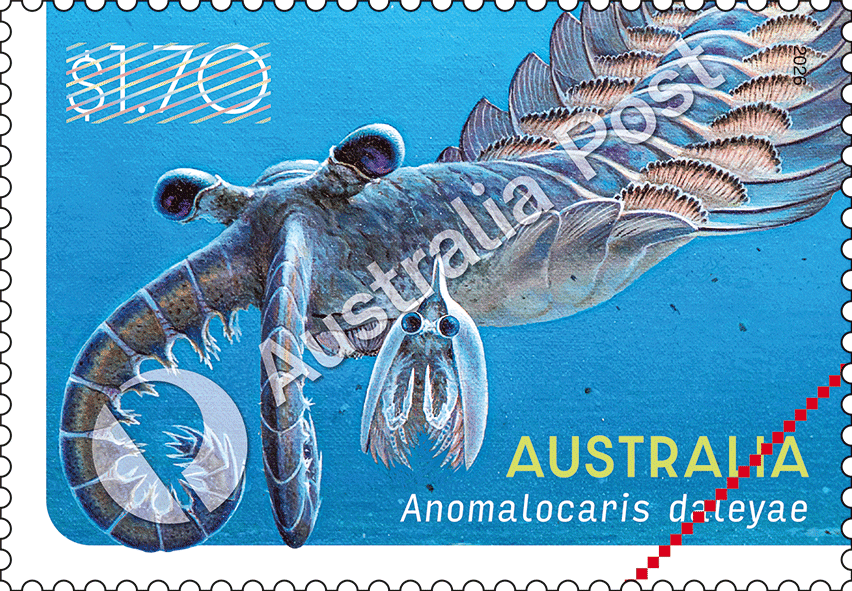
Anomalocaris daleyae
The fierce-looking Anomalocaris daleyae was, at around 50 centimetres long, one of the largest animals in the oceans at that time, and had swimming flaps running along its body, large compound eyes, and a single pair of segmented frontal appendages used to grasp prey.
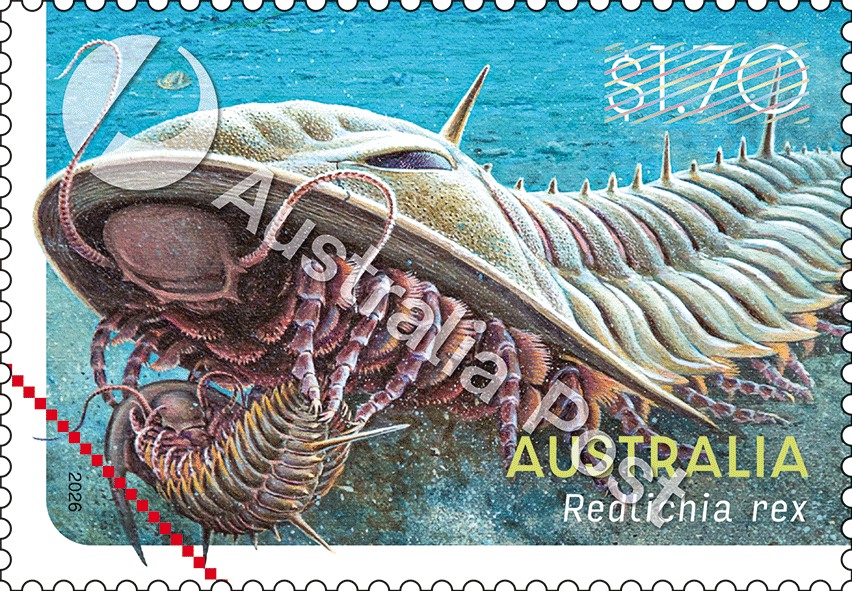
Redlichia rex
The predatory Redlichia rex reached around 25 centimetres in length. Bigger than a dinner plate, this species is the largest trilobite from the Cambrian Period yet found in Australia. A predator, it had formidable legs with spines used for crushing and shredding food. As shown on the stamp, it may have hunted other trilobites.
Shop our Stamp Collectables
-
-
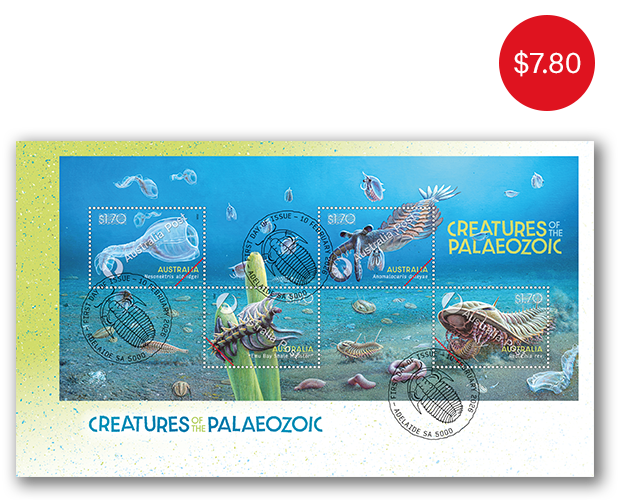
First Day Cover (Gummed)
-
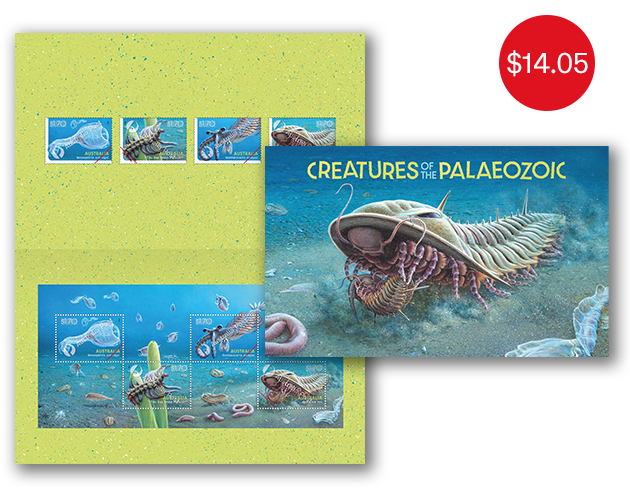
Stamp Pack
-
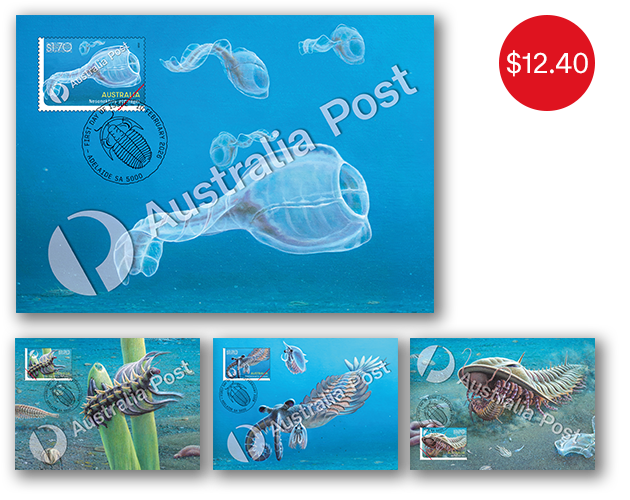
Maxicard (Set of 4)
This content was produced at the time of the stamp issue release date and will not be updated.