Overview
For millennia, First Nations peoples on this land have practised customary forms of medicine and healing. Their complex cultural knowledge and use of natural resources flourishing on Country have ensured their survival and wellbeing for some 65,000 years. Like all societies – ancient and modern – Aboriginal culture has always had gifted healers (sometimes known as ngangkari or maparn). Close observers and skilled practitioners in the art of healing, they’ve brought remedies and relief to their people through their healing touch and application of bush medicine. Their deep cultural knowledge has tended the bodies, minds and spirits of their kin.
Although traditional healing may have been disrupted by Western medicine since colonisation, Indigenous forms of treatment remain strong and active across Australia. (They have also been attracting increased interest, scholarship and use more broadly in recent years.) Adept cultural brokers living at the interface of two worlds and belief systems, First Nations Australians often engage with Western medicine alongside their own healing practices. This is especially so in the case of serious health conditions.
Australia’s many First Nations groups are defined by distinct cultural boundaries that are rooted in their deep relationships to traditional Country and associated Jukurrpa (creation stories), age-old narratives that keep culture thriving. In healing practice, these distinct and ever-present cultural elements operate in concert with the physical and environmental diversity of this vast continent, which determines the botanical and other resources available for use in bush medicines. The shrubs and herbs that grow in tropical north-eastern Australia or the temperate south-east, for example, will be entirely different to those that exist in the dry, sandy interior of Central Australia. But irrespective of a plant’s origin, the indivisible relationship between Country and person is fundamental to bush medicine and customary healing.
Not only traditional healers but also certain elders in communities hold extensive knowledge of bush medicine. Their expertise ranges across the pharmacopoeia of botanical and other sources; when to gather them; what parts of plants to use and for what ailment; and how to prepare and apply remedies to the ailing. Bush medicines often have anti-bacterial or anti-inflammatory effects, and their preparation and application can take many forms; for example, the raw material can be boiled, crushed, burnt or smoked and the preparations might be applied directly to the skin or else inhaled, gargled, consumed or even worn.
Among other ailments, bush medicine can treat wounds, colds, fevers, headaches, skin sores, diarrhoea and stomach disorders. Some common sources of bush medicine and their uses include:
- Beach naupaka (Scaevola taccada): The fruit of this coastal shrub can be squeezed directly into the eye to relieve an irritation. The leaves can also be used directly on sores.
- Dogwood tree / emu bush (Eremophila longifolia): The leaves of this shrub were traditionally used to wash (or were applied to) sores, as well as to treat colds.
- Gum tree (Eucalyptus sp.): Known in some places as ‘Bush Vicks’, the eucalyptus can be used to treat colds, fever and pain. Its leaves are boiled and the steam inhaled.
- Kakadu / billy goat plum (Terminalia ferdinandiana): A potent source of vitamin C, the Kakadu plum has been a food source with great natural health benefits for people in the areas in which it grows.
- Kangaroo apple (Solanum laciniatum and S. aviculare): The fruit of this plant stimulates cortisone production and traditionally was crushed and used as a poultice to reduce swelling.
- Native fuchsia (Eremophila freelingii): The leaves of native fuchsia can be brewed and the infused water then consumed to treat a cold or flu. The leaves were also once boiled with camel fat (more recently olive oil) to treat muscle pain and arthritis.
- Snake vine (Tinospora smilacina): Snake vine would be crushed and tied around the head to treat a headache. It has also been used to treat snake bite and inflammatory disorders, and its sap and leaves used for treating wounds and skin sores.
- Tea-tree / paperbark (Melaleuca alternifolia): This natural antiseptic was used by applying the crushed leaves to a wound as a poultice or by brewing the leaves into a tea to treat a sore throat.
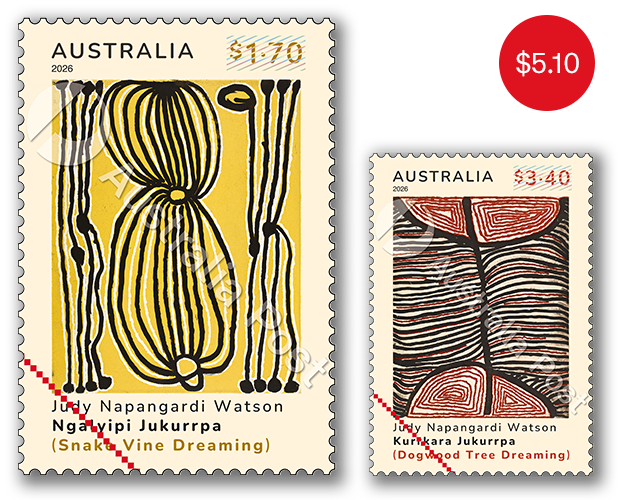
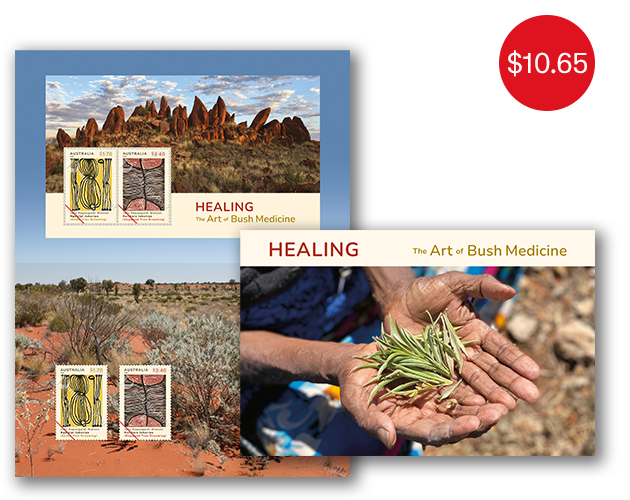
This stamp issue acknowledges bush medicine through contemporary Aboriginal art, a powerful means for sharing knowledge. In depicting bush medicine, the art opens the viewer to an Indigenous perspective on a vital healing practice and the stories that keep it relevant and that keep culture strong.
There is great stylistic diversity in how artists represent this subject, but the stamps in this issue feature two remarkable bold etchings by the late Judy Napangardi Watson (c. 1925–2016). A senior artist from Central Australia and a member of Warlukurlangu Artists of Yuendumu, she lived for long periods at Mina Mina and Yingipurlangu. Her ancestral County incorporates parts of the Tanami and Gibson Deserts, north-west of the Northern Territory township of Yuendumu.
Issue date | 5 May 2026 |
Issue withdrawal date | 1 December 2026 |
Denomination | 1 × $1.70 1 × $3.40 |
Stamp & Product Design | Janet Boschen |
Paper: gummed | Tullis Russell 104gsm Red Phosphor/Blue PVA Stamp |
Printer: gummed | Southern Impact |
Printing process | Offset Lithography |
Stamp size (mm) | 26 x 37.5 |
Minisheet size (mm) | 135 x 80 |
Perforations (mm) | 14.6 x 13.86 |
Sheet layout | Module of 50 (2 x 25) |
FDI Postmark | Alice Springs, NT 0870 |
FDI Withdrawal date | 3 November 2026 |
Stamps in this issue
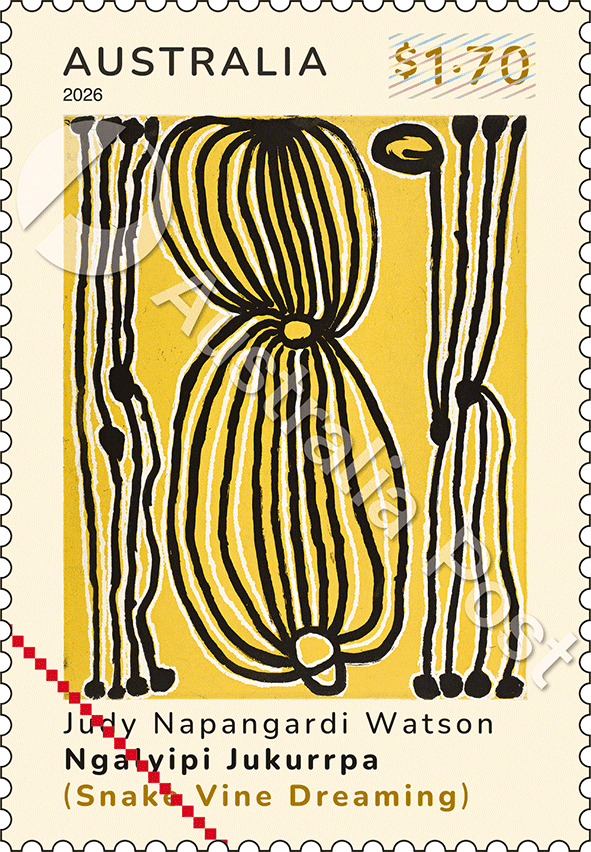
Ngalyipi Jukurrpa (Snake Vine Dreaming)
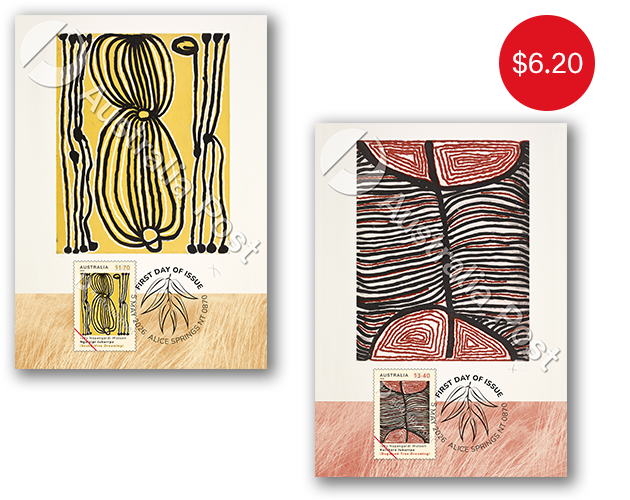
Ngalyipi Jukurrpa (Snake Vine Dreaming) depicts, in the central motif, a plant used for both ceremony and bush medicine that is found on the artist’s Country. Traditionally, parts of the snake vine (Tinospora smilacina) were crushed and tied around a person’s head to treat a bad headache. The plant has also been used to treat snake bite and inflammatory disorders, and its sap and leaves used for treating wounds and skin sores.
Credit: Judy Napangardi Watson, Ngalyipi Jukurrpa (Snake Vine Dreaming), © Judy Napangardi Watson / Copyright Agency, 2025; photograph courtesy of the Medical History Museum, University of Melbourne
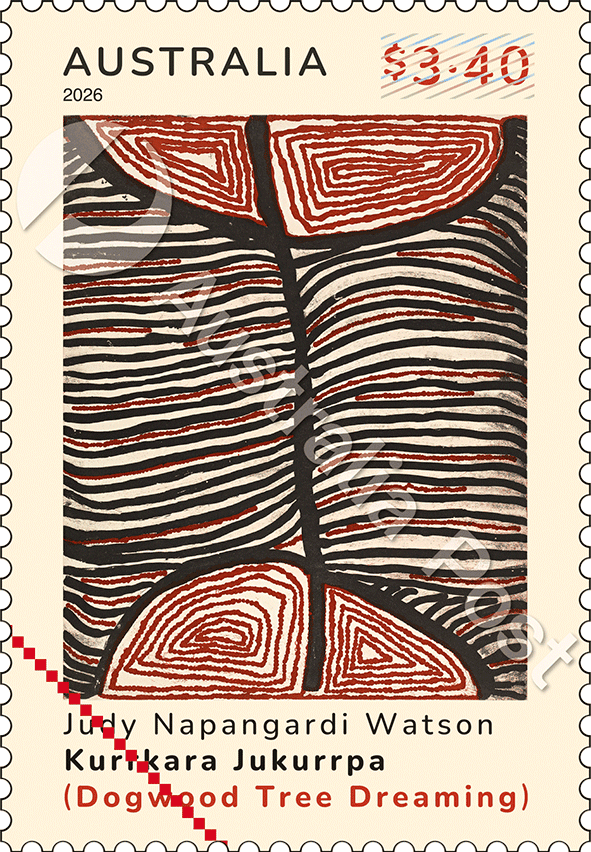
Kurrkara Jukurrpa (Dogwood Tree Dreaming)
The richly coloured etching titled Kurrkara Jukurrpa (Dogwood Tree Dreaming) depicts a creation story in which ancestral women sit to rest under the shade of the dogwood tree (Eremophila longifolia) at Mina Mina during their passage north. Dogwood, also known as emu bush, is a source of bush medicine. Traditionally, the crushed leaves would be rubbed directly on the skin to heal sores and ease body aches. If the leaves are steeped in water, the liquid can be used to wash skin sores or to treat a cold.
Credit: Judy Napangardi Watson, Kurrkara Jukurrpa (Dogwood Tree Dreaming), © Judy Napangardi Watson / Copyright Agency, 2025; photograph courtesy of the Medical History Museum, University of Melbourne
Shop our Stamp Collectables
-
-
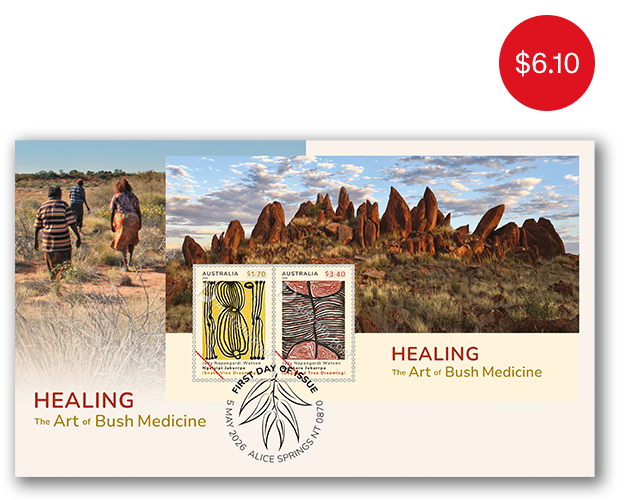
First Day Cover (Gummed)
-
Maxicards
-
Stamp pack
This content was produced at the time of the stamp issue release date and will not be updated.
Shop our Stamp Collectables
-
Stamp Pack
-

Maxicards
-
First Day Cover
-
Stamps